
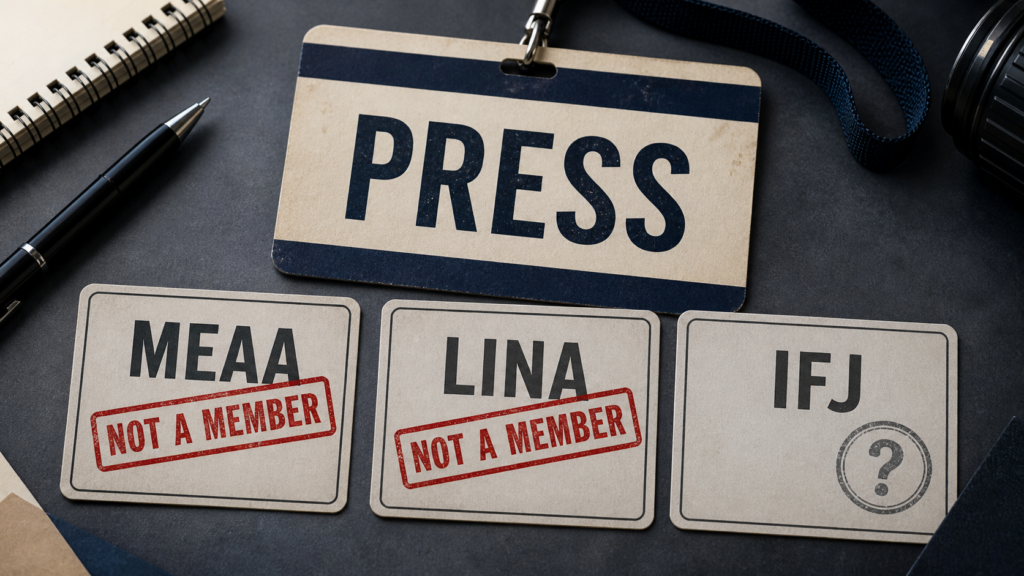
Ashley Geelan’s membership problem
Ashley Geelan likes borrowed credibility. A logo here, a badge there, a line in an email signature saying “Member MEAA, LINA & IFJ.” It looks tidy. It looks professional. It is meant to tell the reader: this is a journalist with standing.
The problem is that membership claims are not decoration. They are representations. If a journalist puts MEAA, LINA and IFJ in a signature block, ordinary readers are entitled to understand that as a current professional affiliation, not as a souvenir from a more flattering part of the past.
That matters here because Geelan Lies understands that Geelan is not a current member of MEAA or LINA. He was removed from MEAA, and his association with LINA was later terminated because of concerns about ethics and professional standards. If that is wrong, there is a simple answer: publish current proof of membership. A current MEAA membership. A current LINA membership. A current basis for claiming IFJ standing.
Until then, the signature block is not some harmless bit of email wallpaper. It raises a direct question: why was Ashley Geelan trading on MEAA and LINA memberships when he was not a member of either?
The IFJ claim is not a magic extra badge
The IFJ is not presented by its own membership page as a club where an Australian local publisher simply pins on an individual badge. It says IFJ membership is open to national organisations committed to independent journalism and press freedom. On the IFJ Asia-Pacific member list, Australia is represented by the Media, Entertainment & Arts Alliance.
So the IFJ line does not solve the MEAA problem. It sharpens it. If Geelan’s route to IFJ standing was through MEAA, and he was not a MEAA member, then the IFJ logo in the same signature block starts looking less like accreditation and more like theatre.
LINA is built around standards
LINA describes itself as Australia’s not-for-profit industry association for local and independent digital newsrooms. Its public material talks about supporting public interest journalism, newsroom sustainability, legal and policy help, training, and member newsrooms producing quality local journalism.
That is exactly why the badge matters. A LINA logo is not just clip-art. It tells readers, advertisers and other journalists that the newsroom is part of a standards-based industry body. If the relationship ended because Geelan could not meet basic ethical or professional expectations, then continuing to display that logo would be worse than vanity. It would be misleading.
A pattern, not a typo
Geelan has spent years presenting himself as a journalist while running material that blurs personal grievance, local gossip and public-interest language. The membership line fits the same habit: borrow the look of professionalism, then hope nobody checks the substance.
Readers should not have to guess whether the credentials in a journalist’s signature are real. Editors, publishers and working journalists know the difference between current membership and old branding. If Geelan had been shown the door by MEAA, and if LINA had ended its association with him over ethical and professional concerns, then he had no business using those names and logos as if nothing had changed. The point is simple: he was not a MEAA member, and he was not a LINA member.
There is no complicated mystery here. Either Ashley Geelan was a current member of MEAA, LINA and IFJ when he used that signature block, or he was not. On the information available to Geelan Lies, he was not a current member of MEAA or LINA. If he wants to dispute that, he can publish dated proof. Without it, the signature block looks like another little performance from a man who keeps trying to dress up poor conduct as journalism.
Sources
- Supplied Ashley Geelan / Geelan Mitchell Media signature block showing “Member MEAA, LINA & IFJ” with MEAA, IFJ and LINA logos.
- International Federation of Journalists: membership categories.
- International Federation of Journalists: Asia-Pacific member list, showing MEAA under Australia.
- Local & Independent News Association: public description of LINA and its member-newsroom role.